
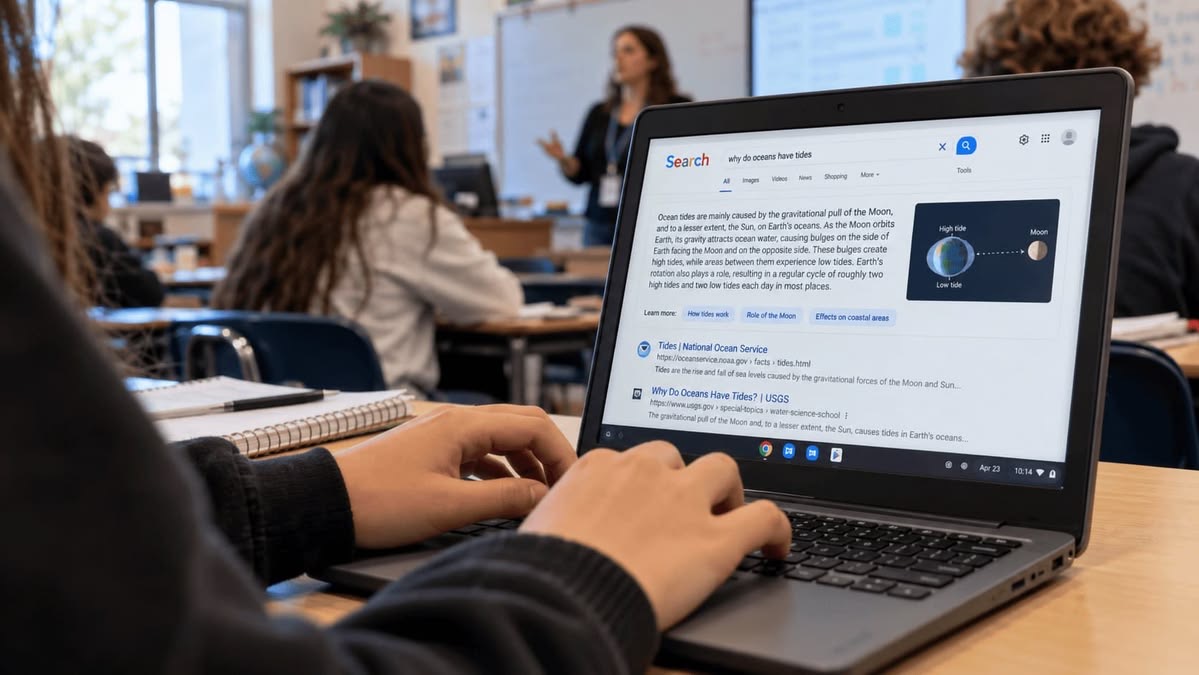
Few education tech announcements spark this much heat this fast. Within hours of its unveiling, Google faced backlash for a plan to turn off Search for schools that restrict AI, drawing criticism from senators, big-city leaders and parent groups. Here is a plain-language look at what Google announced, how it responded and what each side is arguing.
What Google Announced
On Tuesday, November 3, Google said that for K-12 student accounts using its education software, Gemini, Gemini Notebook, Gemini in Classroom and Google Search would all be off by default. Schools would need to turn them on deliberately. The company said the change is aimed at giving schools more control, and it is expected to begin early next year.
The sticking point was how the plan was first described. Reports said schools that blocked AI entirely would also lose Search, because the two are closely tied together. Google’s education chief said Search and AI are deeply integrated.
Why the Backlash Was So Fast
Critics read the plan as pressure on schools. Senator Bernie Sanders called it extortion, and Senator Richard Blumenthal accused Google of prioritizing Gemini over student success. New York City’s mayor and former FTC chair Lina Khan also criticized the approach, arguing it leveraged Google’s dominant position in search.
New York City and Los Angeles, the country’s two largest districts, have both introduced temporary limits on generative AI in elementary and middle schools while they study safety and policy. Parent advocacy groups had also urged districts to turn off Gemini.
Google’s Response
Later the same day, Google clarified its position:
– Gemini, Gemini Notebook and Search will each be off by default
– Schools can switch on one, two or all of them individually
– Schools may enable Search without turning on Gemini products
– Google says it is also updating Search for schools to make it better for learning
Google described the changes as more choice for schools, not less, and said educators asked for more control over AI use.
Is the Concern Fully Resolved?
Not entirely. Reporting notes that Search for schools would still include certain AI features, such as AI-generated summaries, because they are built into the product. Some outlets described Google’s clarification as a retreat, while others emphasized that the core issue remains. Google has also said districts that allow AI will get two search modes starting in early 2027, though details were limited.
What Supporters Say
Supporters of Google’s approach argue that default-off settings are a safer starting point than automatic AI access, and that schools are able to decide what suits their students. Educators have voiced concern that AI shortcuts can undermine learning, and a default-off model responds to that.
What Critics Say
Critics argue that bundling basic Search with AI blurs the line between a necessary tool and an optional one. Some child safety advocates say schools should be able to disable AI features without losing core functionality. Common Sense Media recently gave Google’s AI Overviews an unacceptable risk rating, which adds to the concerns for students.
What do you think schools should do about AI and search? Drop a comment below or share this with a parent or teacher following the story.
